Magnitude 7.4 Earthquake Devastates Pereira, Manizales As Colombia’s Death Toll Climbs To 29
Rescuers dug through rubble in Pereira and Manizales, the hardest-hit cities, as a magnitude 7.4 earthquake killed at least 29 people and collapsed buildings across western Colombia.

Local officials confirmed 18 deaths in the city of Pereira, according to Mayor Mauricio Salazar, and two more in Manizales, according to Mayor Jorge Eduardo Rojas, bringing the confirmed toll to at least 20 as of Monday afternoon local time. The quake struck at 7:34 a.m. near San José del Palmar, a community of about 4,800 people in the Chocó region roughly 250 miles west of Bogotá, according to the U.S. Geological Survey and Colombia's national geological service, both of which recorded the magnitude at 7.4; Colombian authorities had initially reported a lower preliminary magnitude of 6.6 before revising it upward as more data came in. The USGS reported the quake struck at an intermediate depth of 66 miles (107 kilometers) and recorded a magnitude 5.0 aftershock less than an hour later; Colombia's geological service separately reported a magnitude 4.6 tremor in the same region shortly after the main shock. The USGS classified the disaster with an Orange Alert, a designation reserved for earthquakes likely to require a significant regional or national response and typically associated with substantial casualties or damage.
The confirmed death toll climbed to at least 29 as of Monday afternoon, according to a count based on statements from governors and mayors across the affected regions. Eighteen deaths have been recorded in Pereira, according to Mayor Mauricio Salazar; two in Manizales, according to Mayor Jorge Eduardo Rojas; four in the Chocó department; three in Calima El Darién; one in Zarzal, in the Valle del Cauca department; and one in Támesis, in Antioquia — indicating the fatalities span a considerably wider geographic area than the initial cluster of major cities first reported. The quake struck at 7:34 a.m. near San José del Palmar, a community of about 4,800 people in the Chocó region roughly 250 miles west of Bogotá, according to the U.S. Geological Survey and Colombia's national geological service, both of which settled on a magnitude of 7.4 after Colombian authorities' initial preliminary reading of 6.6. The USGS reported the quake struck at an intermediate depth of more than 68 miles and recorded a magnitude 5.0 aftershock less than an hour later. The USGS classified the disaster with an Orange Alert, a designation reserved for earthquakes likely to require a significant regional or national response.
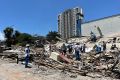
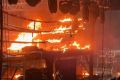
In Cali, a city of roughly 2 million people south of the hardest-hit cluster, Mayor Alejandro Eder said residents were trapped in at least 19 collapsed buildings as rescue crews worked to reach them Monday afternoon. Images from the city showed rescue workers and residents climbing over massive piles of brick, concrete and household debris in search of survivors, working alongside medical personnel who had moved hospital beds into the street to treat the injured near collapse sites. Footage shared by local media outlets showed homes and smaller buildings collapsing in real time in Pereira, Cali and Quibdó as the shaking hit, images that quickly circulated on Colombian social media alongside pleas for information about missing relatives. Chocó Gov. Nubia Carolina Córdoba-Curi said the earthquake caused injuries and serious damage to buildings in the regional capital, Quibdó, a city of about 130,000 people located closest to the epicenter, though she said a fuller damage assessment was still underway and did not provide additional detail. Chocó ranks among Colombia's poorest and most difficult-to-access departments, raising the prospect that the true scope of destruction in more remote, rural parts of the region may not be known for some time.
Bogotá, by contrast, was largely spared structural damage despite residents evacuating buildings and gathering in the streets as a precaution when the shaking reached the capital. Mayor Carlos Fernando Galán said the city was sending 100 rescuers to the Military Transportation Air Command to be deployed to whichever affected cities the national government prioritizes. "No serious structural damage is reported in Bogotá, so our capabilities are at the service of the country," Galán said in a social media post. Strong shaking was felt well beyond Colombia's borders, reaching neighboring Ecuador and Panama to the south and north, respectively, as well as parts of Venezuela to the east; the tremor also reached the Caribbean coastal city of Barranquilla, hundreds of miles from the epicenter. Despite the quake's strength and breadth, Colombia's disaster risk management agency and the Pacific Tsunami Warning Center confirmed no tsunami threat as of Monday afternoon, a determination made roughly five hours after the initial shock.

Flights were suspended at six airports across the affected region — Manizales, Quibdó, Armenia, Cartago, Buenaventura and Pereira — according to Colombian aviation authorities, compounding the difficulty of moving rescue personnel and supplies into the disaster zone. In Pereira, falling ceiling debris struck travelers who had taken shelter inside the airport terminal during the quake, a more precise account than earlier reports of a fuller terminal collapse. International leaders across the United States, South America, Europe and the Middle East have offered to bolster Colombia's rescue efforts, officials said, though Bogotá had not indicated as of Monday afternoon whether it would formally request outside assistance.
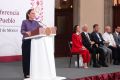
President Abelardo de la Espriella, who was sworn into office Friday after winning June's runoff election by roughly one percentage point, convened an emergency committee Monday to coordinate the government's response and said on social media that he was personally overseeing relief efforts and would travel to the affected region. The earthquake marks the first major natural disaster to test an administration that took office promising a sharp break from the policies of outgoing leftist President Gustavo Petro, including a more hardline approach to domestic security, reduced government spending, and a more conventional foreign policy posture after Petro's government severed diplomatic ties with Israel over the war in Gaza. Israeli Foreign Minister Gideon Sa'ar said in a statement Monday that he had conveyed his concerns to his Colombian counterpart and offered any assistance Israel could provide, a gesture that would have been diplomatically fraught under the prior administration and may serve as an early signal of how the new government engages with international offers of aid.
Monday's disaster also lands in a region still absorbing the aftermath of a separate, deadlier earthquake that struck Venezuela in late June, when the Trump administration mobilized a roughly $150 million relief package and deployed multiple U.S. urban search-and-rescue teams alongside crews from Brazil, Chile, Colombia and Ecuador. Colombian rescue personnel who assisted in that operation gained recent, direct experience with cross-border earthquake response just weeks before facing a comparable disaster at home; whether that experience translates into a faster domestic response, or whether Bogotá instead seeks the kind of international assistance it helped provide to Venezuela, is likely to become clearer in the coming days as the toll from Monday's quake becomes fully known.

How the de la Espriella government manages a disaster spanning multiple major cities simultaneously — rather than a single concentrated impact zone — is likely to be an early marker for a presidency that begins amid a closely and bitterly divided electorate. The logistical challenge is compounded by the geography of Monday's damage: Pereira, Manizales and Cali sit in Colombia's mountainous coffee-growing and southwestern regions, while Quibdó and the epicenter itself lie across the Western Cordillera in Chocó's lowland rainforest, a roughly full day's drive away under normal conditions and likely longer with damaged roads. Coordinating simultaneous rescue and relief operations across that terrain, barely 72 hours into a new administration still staffing key disaster-response posts, represents a significant early operational test regardless of the government's political orientation. De la Espriella campaigned heavily on promises to cut government spending by as much as 40%, a pledge that is likely to face early scrutiny if reconstruction costs across four affected cities strain a budget his administration has pledged to shrink.
Colombia sits along the Pacific Ring of Fire, a zone of intense seismic and volcanic activity that stretches around the Pacific basin, and the country has a long history of damaging earthquakes concentrated in its western and central regions, where the Nazca, Caribbean and South American tectonic plates interact. A magnitude 6.1 earthquake shook Bogotá and central Colombia in August 2023 without causing major structural damage, and Chocó itself was the site of a 1995 magnitude 6.4 earthquake that killed 42 people and injured hundreds more. Colombia's deadliest recent earthquake, a 1999 magnitude 6.2 quake centered near Ibagué, killed roughly 1,900 people and left thousands missing, prompting significant revisions to the country's seismic building codes in the years that followed — codes that Monday's simultaneous building collapses across Pereira, Manizales, Cali and Quibdó may now test in practice, particularly given that intermediate-depth earthquakes like Monday's tend to spread damaging shaking over unusually wide areas compared with shallower quakes of similar magnitude concentrated closer to the surface.
Rescue operations continued simultaneously in at least four cities as of Monday afternoon, with officials in each cautioning that the situation remained fluid and that Monday's confirmed toll of 20 should be treated as a floor rather than a final count. In Cali, the fate of residents trapped in the 19 buildings Mayor Eder identified is likely to be the most immediate driver of whether the death toll rises further in the coming hours, while in Chocó, the pace at which assessment teams can reach more remote and rural communities near the epicenter — long an underserved and hard-to-reach part of the country even in normal times — will determine how much of the disaster's true scope remains unknown even after the visible damage in larger cities is fully tallied. Aftershock risk, which prompted Manizales' mayor to urge residents to remain outdoors, is likely to continue complicating both rescue efforts and any attempt to allow residents back into damaged buildings in the days ahead, while the partial collapse of Pereira's airport terminal adds a further complication to how quickly outside aid and personnel can reach the hardest-hit areas by air.
Originally published on HNGN
© {{Year}} HNGN, All rights reserved. Do not reproduce without permission.
- LO MÁS LEÍDO EN Mundo